
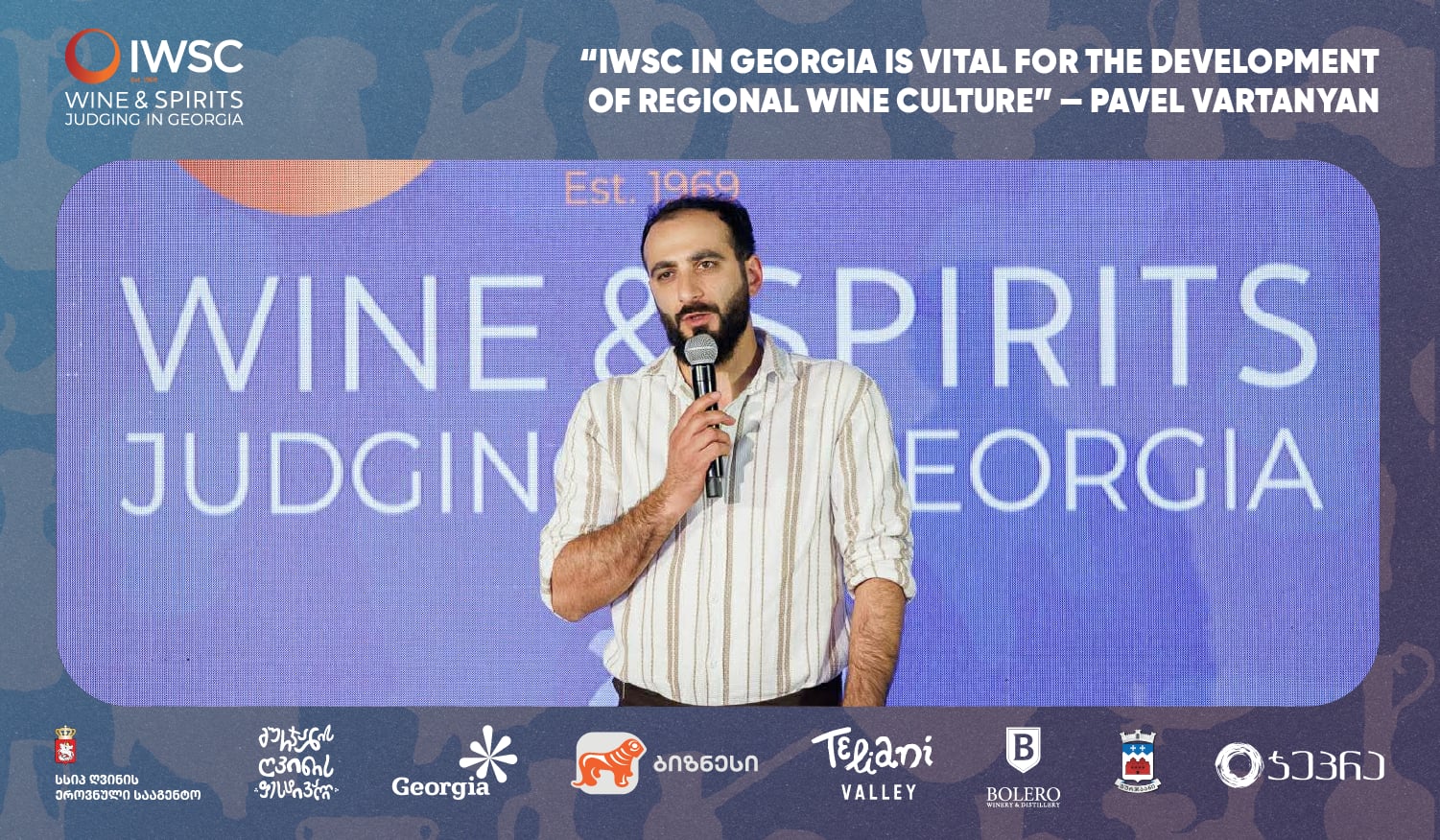
“IWSC in Georgia Is Vital for the Development of Regional Wine Culture” — Pavel Vartanyan
The company Alterra, known in Armenia for its winemaking brand Noah of Areni (NOA), is part of one of Europe’s oldest and most authoritative wine companies. St. Jakobskellerei Schuler & Cie AG, founded in Switzerland in 1694, owns vineyards in Armenia located in the heart of Armenian winemaking — the Vayots Dzor region, in the villages of Rind and Agavadzor, at an altitude of 1,200–1,400 meters above sea level.
The total vineyard area covers approximately 100 hectares, where endemic grape varieties are cultivated, including Areni, Voskehat Tozoti, Khatuni, Milagi, Jirjruk Spitak Areni, Chilar, and others. The company is gradually transitioning to organic/biodynamic viticulture and plans to obtain organic certification in 2026.
Noah of Areni has participated in the international IWSC in Georgia competition for the second time and confidently secured a strong position among the winners. In 2024, the company received 1 Gold and 1 Bronze medal. This year’s competition was particularly successful: Noah of Areni earned 1 Gold and 4 Silver medals. Notably, the company also achieved another milestone this year by receiving an IWSC Trophy.
Following these outstanding results, we spoke with one of the key figures behind this success — Noah of Areni winemaker Pavel Vartanyan:
“I am winemaker Pavel Vartanyan, for whom wine is not merely a profession, but a conscious way of life. My love for my craft is reflected in every stage of the process — from vineyard to bottle. In winemaking, there are no small details: every decision influences the final result, and attention to detail is what creates the character that makes a wine distinctive.
My philosophy is constant exploration and development. I am not afraid of experimentation or stepping beyond conventional styles and technologies, because every new attempt helps reveal the grape, terroir, and time more deeply and authentically. For me, it is not about repetition, but about creating wines with a unique identity. I see wine as a living organism. Every day spent in the cellar is a dialogue with the grape, the land, and time. I trust my intuition, but I always rely on knowledge and strict process control. Honesty and integrity in working with wine are fundamental principles for me.
I create wines not only to be consumed, but to be experienced. Each glass contains emotion, history, and character — of the land, the vintage, and the people behind the wine. I believe wine is art, an experience, and a living history born from love for the land, hard work, and a constant drive for growth.”
Congratulations on your success. The results are truly impressive. Could you briefly introduce your company and explain the key driving force behind your unique value proposition?
Thank you very much. It was a successful year for us at IWSC in Georgia. In short, our company combines centuries-old Swiss winemaking expertise with the unique Armenian terroir. Our modern production facility, equipped with cutting-edge technologies, together with the professionalism and refined intuition of our winemakers, allows us to create wines that harmoniously blend European innovation with Armenian tradition.
What motivated your decision to participate in the IWSC Wine and Spirits Judging in Georgia for the second time?
We participate because independent professional evaluation is important to us. Our goal is not to collect medals. For us, IWSC is a way to test our chosen style, technology, and the quality of our work with grapes. It also allows us to benchmark our wines internationally and understand whether we are developing in the right direction.
Now that the competition has concluded, how would you assess it and your results?
I can assess our results very positively. Receiving gold medals in two consecutive years confirms consistency rather than a one-time success, which is especially important to me as a winemaker. The competition itself and its related events were professionally organized. I would particularly highlight the high level of the jury and the value of their recommendations.
Interaction with colleagues and jury members provided valuable professional contacts and deeper insight into current trends. It was a dynamic and highly beneficial environment for growth and development.
Next year, IWSC in Georgia celebrates its 5th anniversary. Do you plan to participate in the jubilee competition, and what are your future plans?
Yes, we plan to continue participating, but not mechanically. We will submit only those wines that fully reflect our style and philosophy. In the future, we will place even greater emphasis on precise work with terroir and quality control, focusing on the development of signature wines. For us, the competition is a tool for measuring progress.
I believe such competitions play a vital role not only for individual wineries, but also for shaping and developing the wine culture of the entire region. They set quality benchmarks, support professional growth, and raise the overall standard of winemaking.
Awards are always the result of coordinated teamwork that begins in the vineyard and continues through every stage of production. For us, this is neither a final chord nor a reason to stop — it is confirmation of our chosen path and the starting point of a new, higher stage of development.
What are your thoughts on future cooperation and new opportunities for knowledge exchange?
I hope our interactions will not be limited to competitions alone. I would like us to meet more often at wine festivals — in open, vibrant environments where wine becomes a medium for dialogue, experience-sharing, and sincere communication between professionals and enthusiasts alike.
Commersant – https://bit.ly/49qZLrA